01
03
05
Asking a Question
This page walks you through how to interact with Alexi’s chat and conversational features. Alexi is a conversational AI platform, which means you can use natural language to ask your questions.
Here’s a short video walking you through some best practices when asking questions within Alexi.
To ask a question:
1. Navigate to the chat bar at the bottom of your screen.
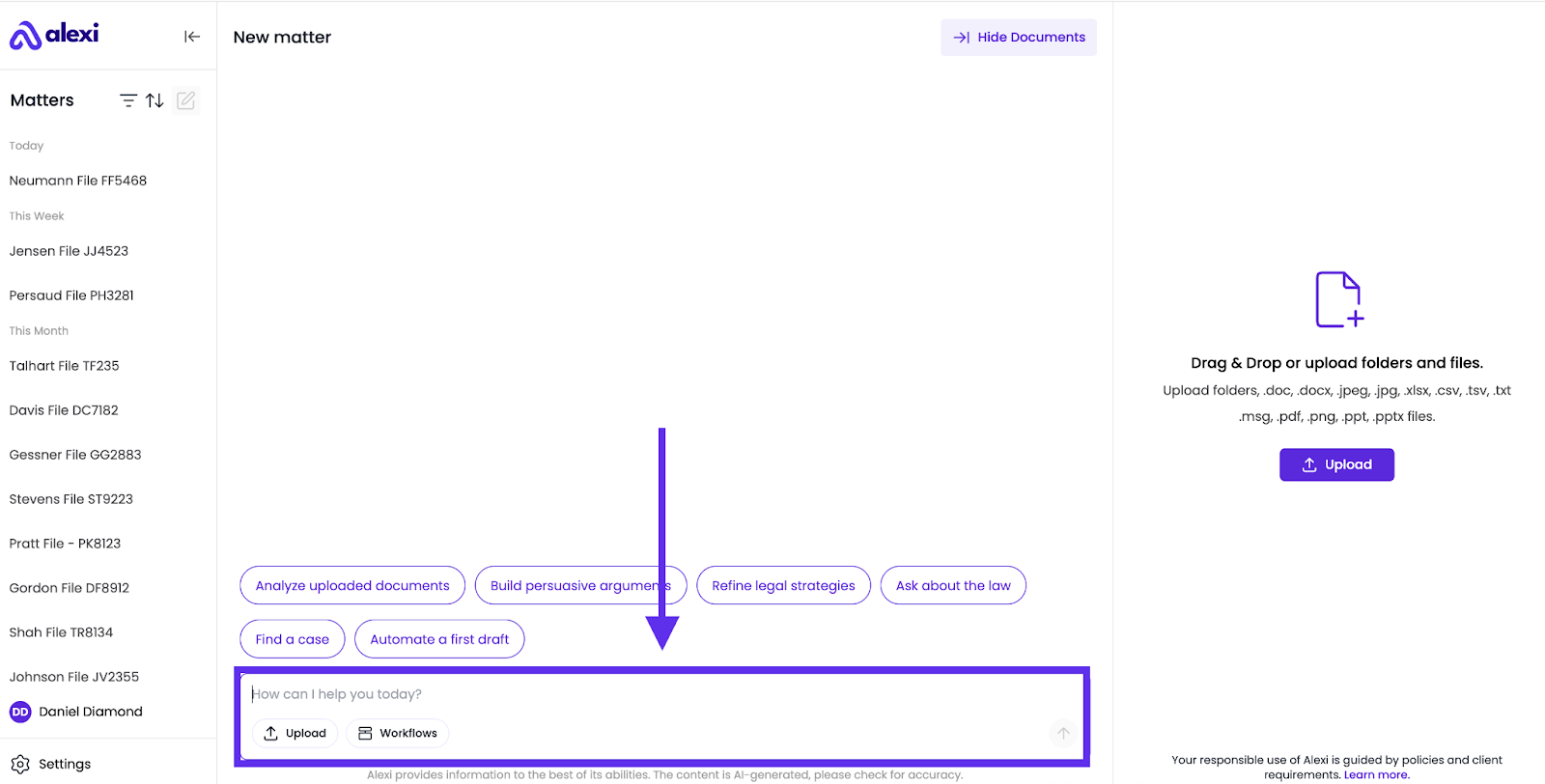
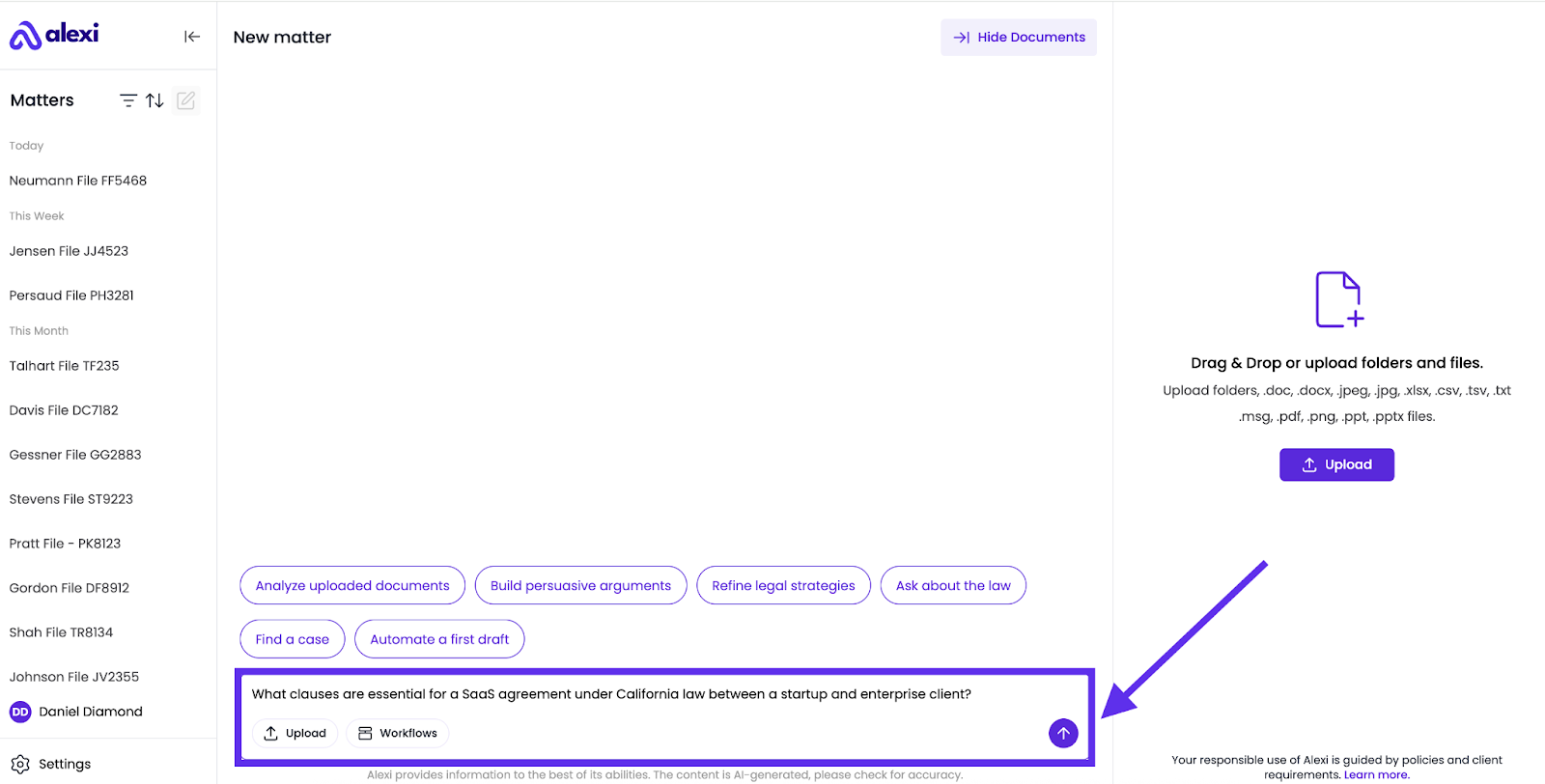
2. Type your question clearly in full sentences, and submit your question by clicking on the purple arrow button or hit Enter.
3. Alexi will generate an answer. Depending on the complexity of your question, this can take anywhere from 3 seconds to 90 seconds. While waiting for the answer to generate, you don’t need to remain on the same page. You may navigate away from the matter, or start a new matter and multitask while waiting for Alexi’s answer to generate.
What does an Ideal Input Include?
An ideal input consists of 3 basic elements:
- Context - Tell Alexi about the file you’re working on, or the work you’re trying to perform.
- Goal - Describe what your ideal outcome would look like.
- Instructions - Provide a task for Alexi to complete (such as finding caselaw, answering a question, helping you strategize, summarizing a document, etc.)
Here are a few examples:
Example Question 1:
I’m drafting an employment agreement for a client in Ontario. The goal is to protect the client’s customer relationships without making it too restrictive. Please suggest an enforceable non-solicitation clause. Do not include a non-compete clause. Structure the clause in clear, professional legal language.
Example Question 2:
I'm working on a commercial litigation file where my client, a supplier of automotive parts, is being sued for breach of contract after allegedly failing to deliver goods on time. My goal is to understand whether the force majeure clause can shield my client from liability in these circumstances and to find supporting case law. Please find examples of cases where force majeure was successfully invoked due to government-imposed shutdowns or similar disruptions in commercial supply agreements.
How can I ask Follow-Up Questions and Iterate?
Think of your interaction with Alexi as a conversation, not a one-time search. The best way to get useful answers is to:
- Start broad – Begin with a general question to get an overview.
- Narrow down – Use Alexi’s first answer to identify areas you want more detail on.
- Ask follow-ups – Build on the previous answers by asking more specific questions.
- Refine further – Continue until you have the clarity, level of detail, or format you need.
This step-by-step approach mirrors how you would research a topic with a colleague: start wide, then zoom in until you have the precise answer.
Example 1:
Step 1 – Broad Question:
What are the general rules around non-compete clauses in Canada?
Step 2 – Narrowing Down:
Can you give me more detail about Ontario’s specific rules on non-competes?
Step 3 – Following Up:
If non-competes aren’t enforceable, what alternatives should I include in an Ontario employment contract in order to protect the employer?
Step 4 – Refining:
Please draft a sample non-solicitation clause tailored for a professional services firm.
Example 2:
Step 1 – Broad Question:
Please review the uploaded documents and provide a high level summary of this file.
Step 2 – Narrowing Down:
Please identify any evidence that might be relevant to the issue of whether the Plaintiff has mitigated their damages.
Step 3 – Following Up:
Based on any relevant caselaw, what are some arguments we can use to support the notion that the Plaintiff did not adequately mitigate their damages?
Step 4 – Refining:
What are some counter-arguments that we can anticipate from opposing counsel?