
The Search for High-Quality AI Document Drafting in Law
The search for high-quality AI document drafting is an effort to find tools that can deliver legal precision, enterprise-grade security, and seamless workflow integration. As law firms evaluate the best AI writing tools of 2025, it's crucial to recognize that not all AI is created equal. The precision, confidentiality, and verifiability required in legal practice set a standard that general-purpose tools, trained on the public internet, often fail to meet. This gap between generic fluency and legal rigor is where quality is either gained or lost.
Choosing the wrong platform can introduce unacceptable risks, from factual hallucinations and outdated legal citations to critical breaches of client confidentiality, ultimately undermining the very quality you seek to improve. A proper evaluation framework must prioritize legal-specific accuracy, uncompromising security, and deep integration into your firm's established workflows. Only by focusing on these core pillars can a firm achieve defensible, consistently high-quality outcomes and harness AI as a strategic asset rather than a liability.
The Benchmark for Legal AI: Core Requirements for Defensible Drafting
To produce consistently high-quality legal documents, your AI platform must be built on a foundation of legal intelligence, process automation, and uncompromising security. These pillars ensure that AI-generated drafts are not just fluent but are also accurate, compliant, and reflective of your firm's highest standards. This benchmark sets a clear line between generic writing assistants and true legal intelligence platforms, providing a framework for measuring the suitability of any AI tool for high-stakes legal work.
The Foundation: Domain-Grounded AI for Verifiable Legal Drafting
Domain-grounded AI is a purpose-built system trained on a specific, curated body of knowledge—in this case, legal sources—to ensure outputs are contextually accurate and verifiable. Unlike generalist AI that pulls from the vast and unreliable expanse of public internet data, a legal intelligence platform is meticulously trained on a curated corpus of millions of North American court documents. This specialized training ensures its outputs are legally sound, contextually relevant, and aligned with current jurisprudential standards.
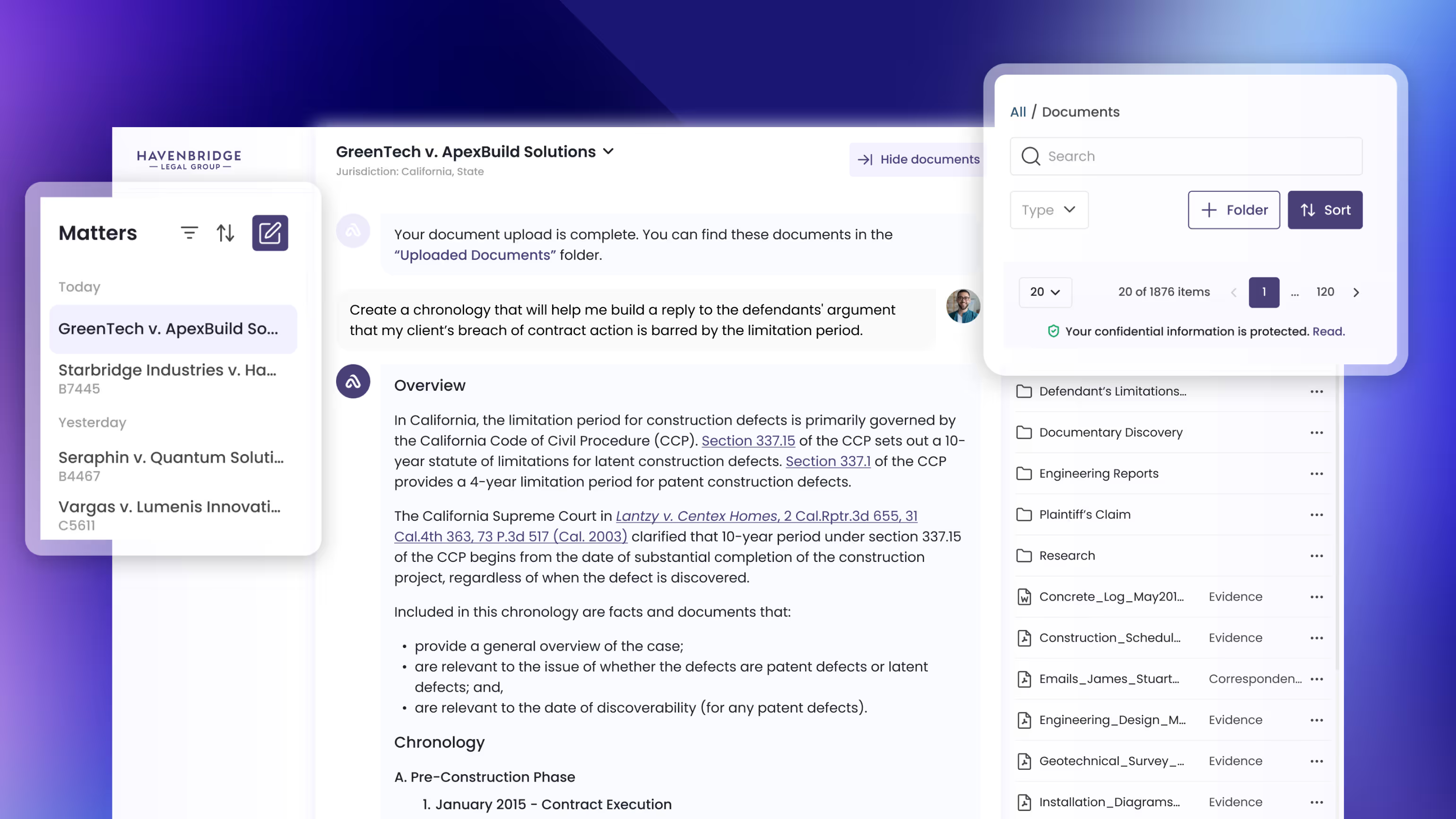
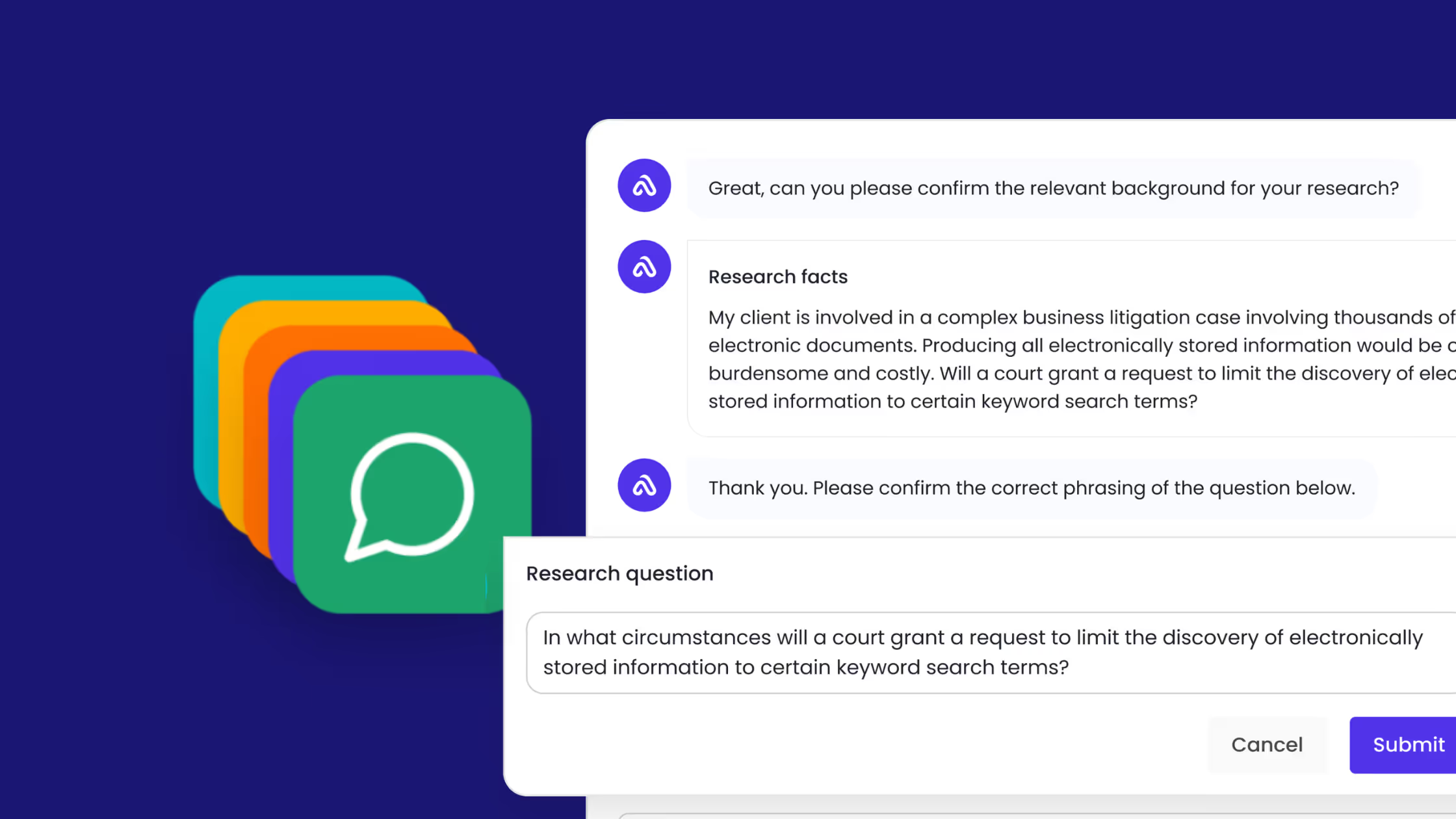
The Alexi Legal Intelligence Platform exemplifies this approach by leveraging Retrieval-Augmented Generation (RAG), a sophisticated technique that dramatically minimizes the risk of error . According to technology leader NVIDIA, RAG supplies sourced, up-to-date context to the model , grounding every draft in verifiable precedent and your firm’s private knowledge base. This process makes outputs auditable and trustworthy, significantly reducing the time attorneys must spend on corrective editing and fact-checking.
Standardizing Excellence: Workflow Automation for Consistent Outputs
Workflow automation standardizes excellence by embedding your firm’s unique drafting and review processes directly into your technology, ensuring every document meets a consistent quality benchmark. An effective AI solution must go beyond simple text generation by integrating into the operational fabric of your firm. It should serve as a central engine for codifying and scaling your team's best practices, turning institutional knowledge into a repeatable, automated process.
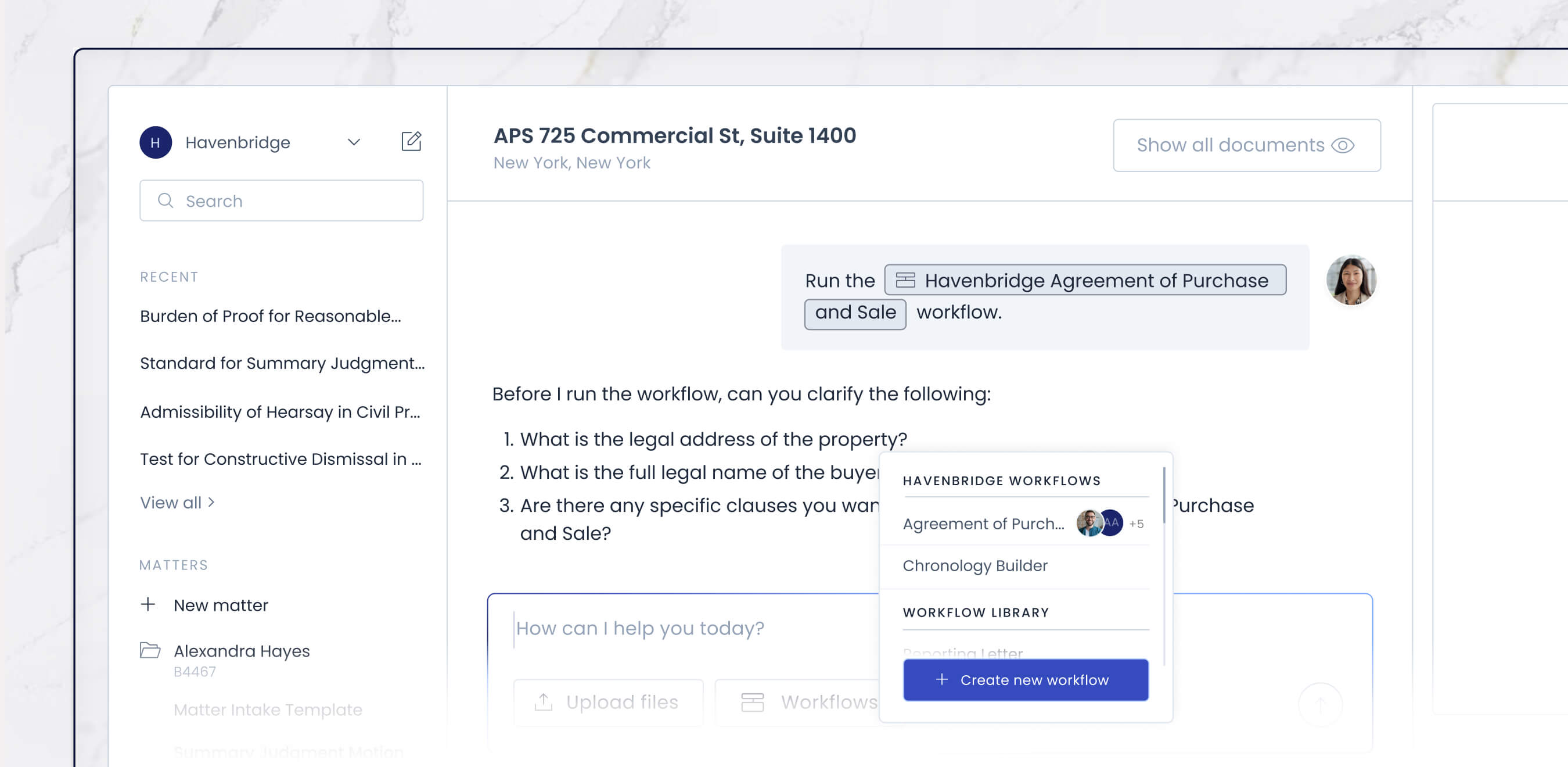
With a dedicated Workflow Library & Automation, a firm can transform its internal standards into a single source of truth that drives consistency across all matters and practice groups. This allows you to automate multi-step drafting and review processes , from initial generation based on approved precedents to final partner approval. By structuring these tasks, firms can achieve consistency in outputs , eliminate common bottlenecks, and free up senior lawyers to focus on high-value strategic work rather than routine oversight.
Protecting Confidentiality: Private Cloud for Secure Legal Intelligence
A private cloud protects confidentiality by providing a dedicated, secure environment for legal intelligence, giving your firm complete control over sensitive client data and insulating it from the risks inherent in shared infrastructure. Your firm's ethical and regulatory obligations demand a controlled, single-tenant environment that generalist platforms, which often rely on multi-tenant public clouds, cannot guarantee. This control is not a luxury but a prerequisite for maintaining client trust and ensuring compliance.
A platform like Alexi offers a Private Cloud Deployment option, providing a secure, isolated environment engineered to meet the highest security and compliance standards. By operating within a private cloud, every query, draft, and piece of analysis remains within your firm's control, shielded from external access and the "noisy neighbor" risks of shared systems. This makes the documentation produced within it more defensible, trustworthy, and aligned with the stringent confidentiality duties owed to every client.
2025 Comparison: Generalist AI Writing Tools vs. Legal-Specific Platforms
Our 2025 comparison reveals that while generalist AI writing tools are powerful for broad tasks, they have critical gaps in accuracy, security, and legal-specific functionality that expose firms to significant risk. These tools are designed for mass-market applications and lack the specialized architecture required for the nuances and high stakes of legal work. Their inability to verify sources, guarantee data isolation, or integrate with legal workflows renders them unsuitable for anything beyond low-risk, preliminary tasks.
ChatGPT for Writing Drafts: Capabilities and Use Cases
OpenAI’s ChatGPT, powered by advanced models like GPT-4o (available through tiers like ChatGPT Plus and ChatGPT Enterprise), is highly effective for generating initial ideas, summarizing non-confidential text, and producing fluent first drafts of general content. Its broad knowledge base, drawn from a vast snapshot of the public internet, makes it a versatile assistant for non-confidential brainstorming and routine writing tasks. For example, it can help structure a basic outline for a presentation or rephrase a paragraph for clarity.
However, its utility in a legal context is severely limited. The model is not trained specifically on legal doctrine and cannot distinguish between authoritative and unreliable sources, often leading to plausible-sounding but factually incorrect statements. While ChatGPT Enterprise offers better security than the consumer version, it does not provide the domain-specific grounding or verifiable accuracy essential for producing defensible legal documents. It remains a general-purpose tool, useful for ancillary tasks but inappropriate for substantive legal drafting.
Anthropic Claude 3 & Google Gemini: Long-Form Content and Multimodality
Anthropic's Claude 3, with future iterations like the anticipated Claude 4 expected to expand on its capabilities, is recognized for its large context window, making it suitable for reviewing and summarizing lengthy documents in a single query. Similarly, Google Gemini offers strong multimodal capabilities, allowing it to analyze inputs that combine text, images, and other data formats. Both are excellent generalist tools for tasks that require understanding long, complex narratives or synthesizing information from diverse sources.
Despite these strengths, their application in legal drafting faces the same fundamental constraints as other generalist models. Their proficiency in processing long text does not equate to legal comprehension. They lack the ability to check citations against primary legal sources or understand the specific jurisdictional nuances critical to accurate legal analysis. Their summarization capabilities are useful for gaining a quick overview of a document but cannot replace the detailed, critical reading performed by a lawyer or a purpose-built legal AI.
Specialized Business Writers: Jasper AI & Writer.com
Platforms like Jasper AI, with its Boss Mode for long-form writing, Writer.com, Writesonic, and Copy.ai are built for corporate content creation. They excel at producing marketing copy, blog posts, and standardized internal communications, helping large teams maintain a unified voice. Writer.com in particular emphasizes enterprise needs with features like brand voice consistency, a private knowledge base to ground outputs, collaborative Docs, strong data privacy controls, and even on-prem deployment options. However, their architecture is not designed for the rigors of legal analysis.
These tools are fundamentally marketing and content-oriented systems. They lack the legal domain training required for defensible drafting and have no built-in understanding of legal structures or arguments. Using them for legal work would be like asking a marketing specialist to draft a complex commercial contract—the tool is simply not designed for the task.
These tools are fundamentally marketing and content-oriented systems. They lack the legal domain training required for defensible drafting and have no built-in understanding of legal structures or arguments. Using them for legal work would be like asking a marketing specialist to draft a complex commercial contract—the tool is simply not designed for the task.
Embedded Assistants: Microsoft 365 Copilot, GrammarlyGO, and Notion AI
Embedded tools offer convenience by integrating directly into daily software applications, providing assistance within the user's existing workflow. The official Microsoft 365 Copilot in Word can draft sections, reformat text, and summarize content without making the user switch windows. The GrammarlyGO feature, part of Grammarly Business, provides real-time grammar checks and light drafting suggestions, while Notion AI helps organize notes and compose text with features like Write and Compose within its versatile workspace.
These assistants are highly useful for general office productivity but operate at a surface level, lacking any deep legal intelligence. Copilot's suggestions are based on general language patterns, not legal precedent. GrammarlyGO can correct syntax but cannot advise on the substantive accuracy of a legal clause. Notion AI can structure information but cannot verify its legal validity. They are helpful for polishing the final layer of a document but are not equipped to handle the foundational work of legal research and drafting.
Feature-by-Feature: Alexi vs. Generalist AI Drafting Platforms
A direct feature comparison underscores the fundamental divide between a purpose-built legal intelligence platform and generalist AI writers. Alexi provides specific, defensible advantages in the areas that matter most to law firms: accuracy, security, and process control.
- Verifiable Accuracy: Alexi provides verifiable accuracy by grounding every draft in curated legal sources and your firm’s private precedent. Its Retrieval-Augmented Generation (RAG) engine produces auditable outputs, complete with citations, directly addressing the hallucination risks inherent in generalist models.
- Uncompromising Confidentiality: Alexi ensures uncompromising confidentiality through a private cloud, single-tenant deployment. This architecture gives your firm complete control over its data and AI models, meeting stringent compliance requirements and eliminating the data commingling risks associated with the shared infrastructure of generalist platforms.
- Integrated Workflow Standards: Alexi integrates firm-wide standards through its dedicated Workflow Library. This allows you to codify and automate complex legal processes, from drafting to review and approval, ensuring consistent quality at scale. This contrasts with generalist tools, which function as disconnected writing assistants and lack any mechanism for embedding or enforcing firm-specific operational protocols.
Choosing the Right AI for Quality and Compliance
While the best AI writing tools of 2025 offer powerful general capabilities, they are not interchangeable with legal intelligence platforms when it comes to drafting high-quality, defensible legal documentation. Generalist models like ChatGPT, Claude, and Copilot lack the domain-specific training, security architecture, and workflow integration required to meet the rigorous standards of the legal profession. Relying on them for substantive work introduces unacceptable risks to quality, confidentiality, and professional reputation.
For firms committed to enhancing quality, ensuring consistency across every matter, and protecting client data with the utmost diligence, a purpose-built platform is the only viable path forward. The choice is between a generic tool that creates more review work and a specialized platform that streamlines it. By investing in an AI solution engineered for the law, firms can fundamentally change their drafting processes, elevate their work product, and build a sustainable competitive advantage.
Ready to elevate your firm’s legal documentation quality and efficiency? Explore Alexi’s Core AI Capabilities today .
Blogs you might be interested in:






.avif)





.avif)

.jpeg)

%2520(1).jpeg)


.avif)

.avif)
.avif)

.avif)
.avif)


.avif)


.avif)

.avif)




.avif)

-min%25252520(1).avif)